


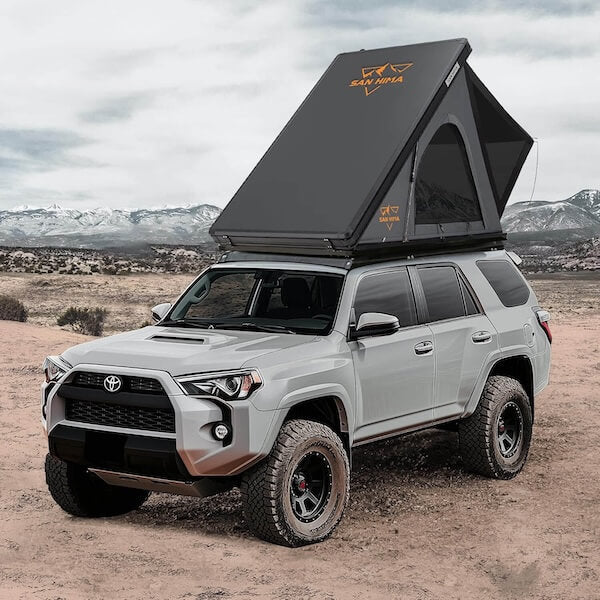
- A hardshell rooftop tent uses gas struts to open quickly, while a softshell needs its cover unfolded and spring poles fitted.
- Low-profile hardshells create less aerodynamic drag, with fuel economy dropping by a maximum of 10% compared with up to 30% for fold-outs.
- The San Hima Kalbarri Gen 2 sets up in less than one minute and sleeps three.
- Always check your vehicle's dynamic roof load rating before mounting a rooftop tent.
Rooftop tents (RTTs) come in hardshell and softshell versions. Each provides temporary accommodation for off-road drivers, but you need to decide which suits you best. A hardshell rooftop tent is a tent with a rigid outer shell that lifts open, usually on gas struts. A softshell rooftop tent is a tent with a folding platform and a fabric cover.
Browse our full hardshell rooftop tent range to compare options.
The Setup Speed Advantage: Gas Strut Activation vs Manual PVC Covers
Your choice of rooftop tent may come down to how quick and easy it is to put up.
Softshell with manual PVC cover
- It is similar to a traditional ground tent and is mounted on a folding platform.
- The cover needs to be unlatched and unfolded, with flexible steel spring poles inserted into the base.
- After use, the tent has to be folded down and repacked.
- All this takes time and effort at roof level, which is harder in unfavourable weather.
Hardshell with gas struts
- Internal gas struts lift the roof and tension the fabric once the cover is unlatched.
- Repacking is equally quick, since pulling down a strap compresses the struts.
Aerodynamics and Fuel Efficiency: Comparing Low-Profile Shells to Bulky Foldouts
Fold-out tents can offer greater living space, but they are bulkier than low-profile shells. As a result:
- Low-profile shells cause much less aerodynamic drag than foldouts that stand higher.
- Fuel economy can drop as much as 30% when driving with a fold-out, whereas the maximum for a low-profile shell is 10%.
- The low centre of gravity of a shell means better handling, reduced susceptibility to crosswinds and less wind noise.
Weather Resistance on the Trail: Wind Stability and Rain Protection
For off-roaders, comfortable sleeping conditions are essential, and so is travelling convenience.
| Feature | Hardshell | Softshell |
|---|---|---|
| Setup | Gas struts lift the roof | Cover unfolded and spring poles inserted |
| Driving noise | Low profile, aerodynamic shape | Noisier, as wind gusts move the fabric |
| Wind | Rigid frame and solid walls, relatively safe in high winds | Strong winds can make erection and sleeping difficult |
| Rain | Smooth surfaces aid run-off and sealed perimeters prevent leaks | Relies on strong seams, though the fold-out design creates an awning that keeps the entry dry |
| Storage when packed | Space for sheets and similar items | Minimal space |
Key Features of the San Hima Kalbarri Gen 2 Hardshell Setup
The San Hima Kalbarri Gen 2 hardshell rooftop tent has many features that make it a popular choice:
- A spacious size that accommodates three people.
- A memory foam mattress and anti-condensation mat for comfort.
- Lighting from a skylight window and LED strips with variable settings.
- Gas struts and key latches for set-up in less than one minute.
- Tough poly-cotton fabric and UV protection.
- An insulated base that controls the temperature, and a 5,000-millimetre waterproof rating that protects from rain.
- A 2 to 3 metre telescopic ladder, storage pockets and shoe bags.
Explore more from the San Hima range, or add a rooftop tent mattress for extra comfort.
Roof Load Limits and Mounting Requirements for Australian Dual-Cabs
Dynamic and static ratings
The dynamic rating is the legal and safe weight limit when driving. It is set by manufacturers and is generally 65 to 100 kilograms for most dual-cab utes. This must not be exceeded. Subtract the weight of racks, crossbars and accessories to determine your payload capacity.
The static rating (when parked) is typically 2 to 3 times the dynamic rating. The dynamic rating may be reduced by up to one third when driving on rough terrain.
Mounting requirements
- Most dual cabs have four factory mounting points.
- Heavy accessories such as rooftop tents may need a reinforced rack platform with additional mounting points. See our roof racks for options.
- If mounting to a ute canopy, ensure it can handle the load. This is typically 50 to 80 kilograms for fibreglass and higher for aluminium. Check out our ute tub canopies.
- Loads must not extend more than 15 centimetres over the vehicle's sides or 1.2 metres at the rear (without warning flags).
- Total width must not exceed 2.5 metres.
Internal Storage and Bedding Capacity During Pack-Down
One advantage of a hardshell tent is that there is space to store sheets and similar items when it is packed down. These need to be stored carefully and within the weight limit. Space within a closed softshell tent is minimal.
FAQ
What is the difference between a hardshell and softshell rooftop tent?
A hardshell rooftop tent has a rigid shell and uses gas struts to lift the roof once unlatched. A softshell has a folding platform and a PVC cover that must be unfolded and fitted with spring poles. Hardshells are generally quicker to set up and pack down.
How fast does the San Hima Kalbarri Gen 2 set up?
The San Hima Kalbarri Gen 2 uses gas struts and key latches, so set-up takes less than one minute. Repacking is also quick, because pulling down a strap compresses the struts. It accommodates three people and includes a memory foam mattress and an anti-condensation mat.
Do hardshell tents affect fuel economy less than fold-outs?
Yes. Low-profile hardshell tents cause less aerodynamic drag than fold-outs that stand higher. Fuel economy can drop by as much as 30% with a fold-out, compared with a maximum of 10% for a low-profile shell. The lower centre of gravity also improves handling and reduces wind noise.
What roof load limit applies to a rooftop tent on a dual-cab ute?
The dynamic rating is the legal and safe weight limit when driving. It is set by manufacturers and is generally 65 to 100 kilograms for most dual-cab utes. Subtract the weight of racks, crossbars and accessories to find the payload capacity available for your tent.

Leave a comment
This site is protected by hCaptcha and the hCaptcha Privacy Policy and Terms of Service apply.