


You’re halfway through a trail when it happens.
The ground looks solid—until your tires spin, sink, and stop moving forward.
Now you’re stuck.
At that moment, the decision becomes simple:
Do you pull yourself out—or drive yourself out?
That’s the core difference between recovery tracks and winches.

Two Different Recovery Approaches
At a fundamental level:
- Recovery tracks → restore grip so you can drive out
- Winch → pulls the vehicle out regardless of traction
This distinction matters more than specs, because terrain—not equipment—determines what actually works.
When Recovery Tracks Work Best
Recovery tracks are most effective when your vehicle isn’t blocked—it just lacks traction.
- Soft sand
- Loose dirt
- Snow
- Light to moderate mud
In these cases, tracks act as a temporary surface under your tires.
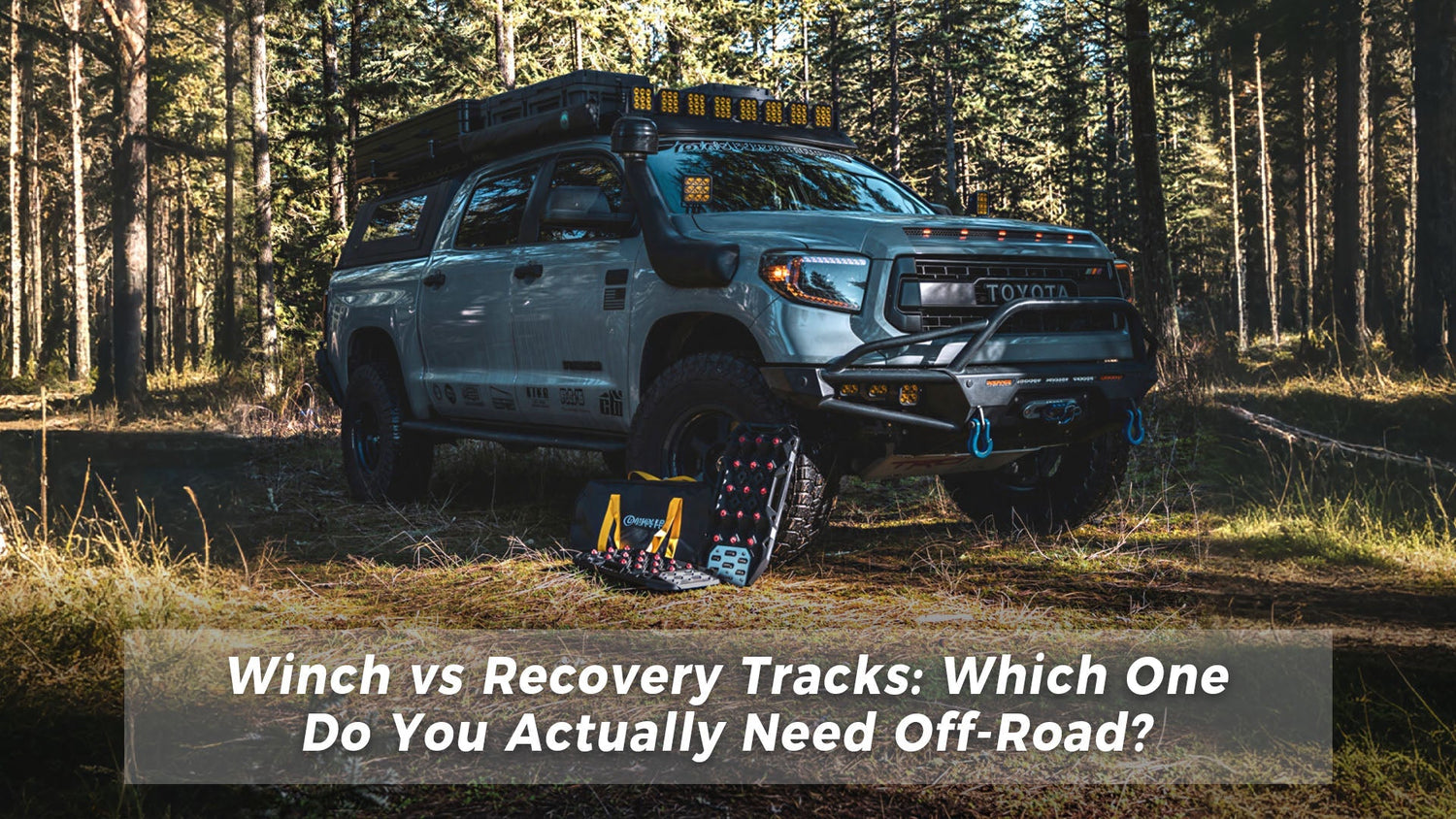
BUNKER INDUST GEN 10 Recovery Tracks are designed for this:
- Cross-shaped teeth help reduce wheel spin
- Contoured ramps allow tires to climb instead of dig
- Dual-sided structure stabilizes soft ground
- Lightweight design allows quick deployment
The biggest advantage is speed—no setup, no anchors. Just place them and drive out.

Where Recovery Tracks Struggle
Recovery tracks rely on one key factor: your tires must still be able to move the vehicle.
- The vehicle is bellied out
- Mud is too deep or thick
- You’re on a steep incline
- There’s no forward momentum
In these cases, traction alone isn’t enough.

When a Winch Becomes Essential
When your vehicle is fully immobilized, a winch becomes the only viable solution.
A winch works by physically pulling the vehicle out of the obstacle, rather than relying on traction.
- High pulling force for heavy recovery
- Controlled torque via gear system
- Strong synthetic rope for safety
Where Winches Excel
- Deep mud or clay
- Rock obstacles
- Steep inclines
- Fully stuck vehicles
- Technical off-road terrain
What to Expect When Using a Winch
Winches are powerful—but not instant.
- Require a solid anchor point
- Need proper rigging
- Depend on correct technique
They offer greater capability, but involve more setup and skill.
Recovery Tracks vs Winch
| Factor | Recovery Tracks | Winch |
| Setup time | Very fast | Moderate |
| Skill required | Low | Medium–High |
| Recovery type | Traction-based | Force-based |
| Severe terrain | Limited | Excellent |
| Solo recovery | Excellent | Depends on anchor |

Final Thought
This isn’t really a “winch vs recovery tracks” decision.
- Recovery tracks help you keep moving
- Winches help you recover when movement stops
The right tool isn’t the one with the best specs—it’s the one that matches the situation.


Leave a comment
This site is protected by hCaptcha and the hCaptcha Privacy Policy and Terms of Service apply.